Is Your Loft Ready for Winter? A Practical Checklist for West Midlands Homes
As the temperature starts to drop across Birmingham and the West Midlands, most of us think about turning the heating back on, checking the boiler and finding the winter coats.
The loft rarely gets the same attention.
Yet autumn is one of the best times to take a proper look upstairs. A loft that seemed perfectly fine during summer can behave very differently once the house is heated and the roof space becomes colder.
Flattened insulation, blocked airflow, condensation, difficult access and boxes balanced across joists are all worth dealing with before winter properly arrives.
If you already use your loft for storage, or you are thinking about creating more space before Christmas, here are the things we recommend checking first.
1. Check what is underneath your stored boxes
It is surprisingly common to find belongings sitting directly on insulation, old loose boards or sheets of timber placed across ceiling joists.
It might work for a couple of lightweight boxes, but it is not a particularly practical long-term storage arrangement.
More importantly, putting boards or belongings directly onto deep loft insulation can squash it.
Insulation relies on its structure to trap air. Compressing it can reduce its effectiveness, which is exactly what you do not want as temperatures fall and the heating is being used more often.
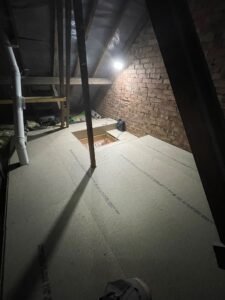
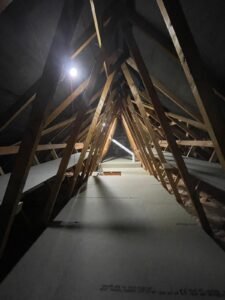
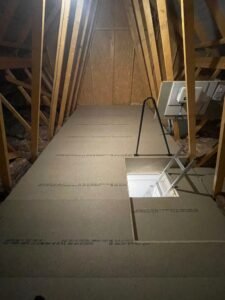
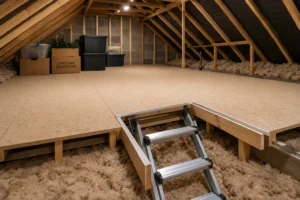
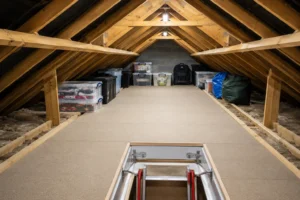
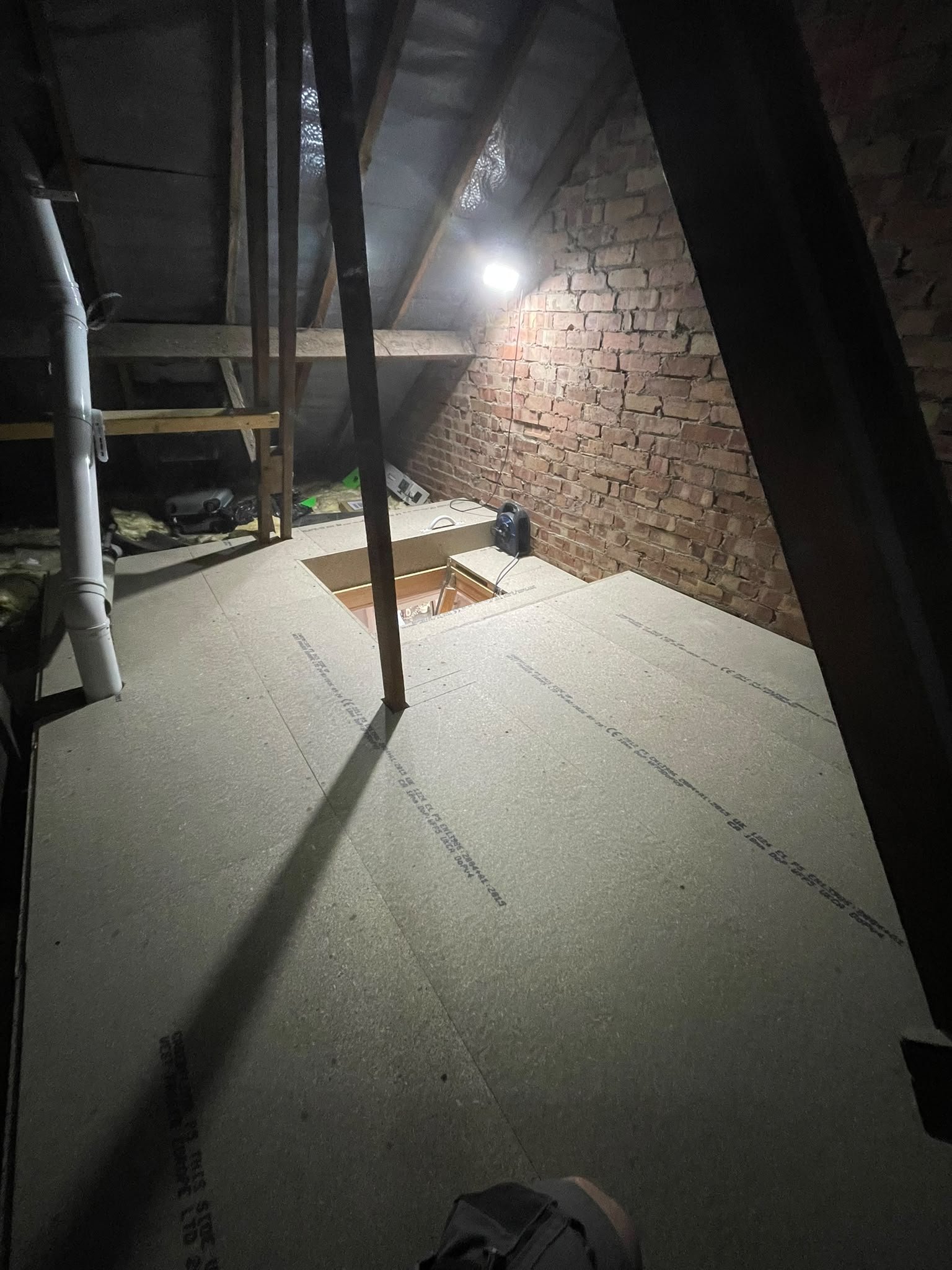
If you need a proper storage floor, raised loft boarding provides a separate platform above the insulation rather than simply pressing boards down onto it.
That gives the insulation and storage area two separate jobs: the insulation helps retain heat below, while the raised floor provides a practical area for household storage above.
2. Have a look at the condition of your insulation
You do not need to be an insulation expert to spot some of the more obvious problems.
Look for areas where the insulation has been:
- flattened by stored belongings
- pushed aside to make room for boxes
- disturbed around old boarding
- left significantly lower in one section
- affected by visible moisture
- moved away from areas where previous work has taken place
An older loft may also have insulation installed at different times, so one part of the roof space can look very different from another.
Do not simply add more insulation without considering the rest of the loft.
Ventilation, electrical cables, pipework, existing boarding and access all need to be taken into account.
If the insulation looks uneven, compressed or inadequate, our loft insulation service can be considered at the same time as any new storage platform.
Planning the two together is usually much more sensible than upgrading the insulation and then discovering that the existing storage floor no longer works.
3. Look for early signs of condensation
A cold morning is often a better time to spot moisture problems than a warm afternoon in August.
When warm, moisture-laden air from the home reaches colder parts of the roof space, condensation can form. Restricted ventilation can make the situation worse.
Things worth looking out for include:
- droplets on the underside of roofing materials
- damp patches on roof timbers
- a persistent musty smell
- wet cardboard boxes
- rusty metal fixings
- mould appearing on timber or stored items
- insulation that feels damp
Finding condensation does not automatically mean that the roof is leaking.
It also does not mean that adding more insulation alone will solve the problem.
The source of the moisture, the ventilation available and the arrangement of the insulation all need to be considered.
If airflow around the edges of the loft has been blocked by insulation or stored belongings, simply covering more of the floor with boards can make matters worse.
Our loft ventilation service can be considered where airflow needs attention as part of the wider loft setup.
4. Do not block the edges of the roof with storage
When homeowners want more space, there is a temptation to push boxes as far into the eaves as possible.
Those areas can be awkward to reach and may also form part of the ventilation arrangement within the roof.
For many homes, trying to use every last centimetre of loft floor is unnecessary.
A properly positioned central storage platform can often provide more useful space because it keeps belongings where there is reasonable headroom and straightforward access.
It can also leave low areas around the roof edges clear.
This is one reason we do not automatically recommend boarding an entire loft.
The objective should be usable storage, not the largest possible boarded measurement.
If you are unsure how much space you actually need, our guide on how much of your loft you should board explains this in more detail.
5. Think about what will actually go into the loft this winter
Autumn is when loft storage starts earning its keep.
Garden cushions are packed away, suitcases are put back after summer holidays and Christmas decorations will soon be coming down.
It is a useful time to ask a simple question:
Can you actually reach the things you store without climbing over everything else?
A loft containing 30 square metres of badly organised storage may be much less useful than a smaller boarded platform with a clear route from the hatch.
Try organising belongings by how often you use them.
Christmas decorations and seasonal items should be reasonably easy to reach. Things that are rarely needed can go further back.
Use suitable closed storage boxes rather than loose cardboard wherever practical, particularly for items that could be affected by dust or changes in humidity.
Most importantly, do not let a newly boarded loft become an excuse to fill every available space.
The roof structure, services and areas requiring inspection still need to remain accessible.
6. Check the loft hatch before the really cold weather arrives
The loft hatch is easy to overlook because it is normally closed.
Stand underneath it on a cold day, however, and you may notice a draught or a clear temperature difference around the opening.
An old or poorly fitting hatch can also make accessing the loft unnecessarily awkward.
Consider whether:
- the hatch closes properly
- there are obvious gaps around it
- the opening is large enough for the items you store
- it is insulated appropriately
- the position works with the ladder and boarded area
Sometimes improving the hatch makes a bigger practical difference than adding another few square metres of boarding.
You can see the available options on our loft hatches page.
7. Ask yourself whether the loft ladder is suitable for regular use
Dragging a household stepladder upstairs every time you need the Christmas decorations is not ideal.
Neither is trying to carry a storage box while climbing through a small opening.
If the loft is going to become part of your regular household storage, access should be planned alongside the floor.
A suitable loft ladder can make the difference between a loft that is technically available for storage and one that you actually use.
The right option depends on the hatch, ceiling height, space below the opening and how frequently you expect to access the loft.
This is why we assess the access arrangement rather than treating the ladder as an afterthought.
8. Make sure you can actually see where you are stepping
Winter also means shorter days.
A loft that seemed reasonably bright when you opened the hatch on a summer afternoon can be extremely dark at five o’clock in December.
Holding a torch in one hand while carrying a box with the other is not a good storage system.
Lighting around the hatch, boarding and main storage route can make the space considerably easier to use.
If you are already planning new boarding, it makes sense to consider loft lighting before the storage area is filled with belongings.
What about loft boarding during winter?
There is no need to wait until spring simply because the weather has turned colder.
In fact, autumn and winter can highlight some of the problems that are easier to overlook during warmer months.
The important part is assessing the loft before deciding what to install.
At Your Loft 4 Storage, we look at the existing insulation, access, useful headroom and layout before recommending the boarding area.
Where the insulation sits above the ceiling joists, a raised system can create a separate storage deck rather than compressing the insulation underneath.
If you want to understand this in more detail, read our guide: Does Loft Boarding Affect Insulation?
Preparing lofts for winter across the West Midlands
We work with homeowners across Birmingham, Wolverhampton, Dudley, Walsall, Coventry and the wider West Midlands, as well as surrounding areas.
No two lofts are quite the same.
Some already contain old boards. Others have deep insulation but nowhere safe to put a box. Some have plenty of potential storage space but a hatch that is simply too awkward for regular use.
That is why we recommend looking at the loft as a complete space rather than treating boarding, insulation and access as separate problems.
For example, a homeowner considering loft boarding in Birmingham may only need a practical raised platform near the hatch rather than the entire roof space covered.
Another property may benefit more from improving the hatch and ladder before adding extra storage.
The right solution depends on what is already there and how you intend to use it.
A simple winter loft checklist
Before the colder weather settles in, take ten minutes to check:
- Is your insulation still evenly distributed?
- Has anything been stored directly on top of it?
- Can you see signs of condensation or damp?
- Are ventilation areas being blocked by belongings?
- Is existing boarding stable and properly positioned?
- Can you reach your storage without stepping across exposed joists?
- Does the loft hatch close properly?
- Is access with your current ladder comfortable?
- Is there enough lighting to use the loft safely?
- Can important pipework, cables and services still be reached?
If several of those questions reveal problems, it may be worth having the loft assessed before adding more storage.
Make better use of your loft this winter
A useful loft does not need to be complicated.
A well-planned storage platform, suitable access and insulation that has not been squashed can transform a previously awkward roof space into somewhere you can actually use throughout the year.
Your Loft 4 Storage installs raised loft boarding, loft ladders, hatches, insulation, lighting and other practical loft improvements across the West Midlands and surrounding areas.
If you are thinking about sorting your loft before winter, we can assess the existing space and explain the options available.
Arrange a free home survey and no-obligation quotation.
Call 0800 193 5051 or email info@yourloft4storage.co.uk.
Frequently Asked Questions
Can loft boarding make condensation worse?
Poorly planned boarding can contribute to problems if it compresses insulation or restricts ventilation. A raised storage system keeps the boarding separate from the insulation, but any existing condensation or ventilation issue should still be assessed rather than simply covered over.
Should I add insulation before boarding my loft?
If the insulation needs upgrading, it is usually sensible to consider the insulation and proposed storage floor together. This allows the height and layout of any raised boarding to be planned around the insulation beneath it.
Do I need to board my entire loft?
No. For many homes, a central storage platform close to the hatch provides all the useful storage required. Low or difficult-to-reach areas can often be left unboarded.
Can I store Christmas decorations in the loft?
A dry, accessible loft with suitable storage is commonly used for seasonal belongings such as Christmas decorations. Keep items in suitable containers, avoid blocking ventilation routes and do not overload the storage area.
Is autumn a good time to have loft boarding installed?
Yes. Autumn can be a particularly useful time to assess your loft because you are approaching the period when insulation, storage and access become more noticeable. The suitability and scope of any installation still depend on the individual property.